Radical Reconstruction
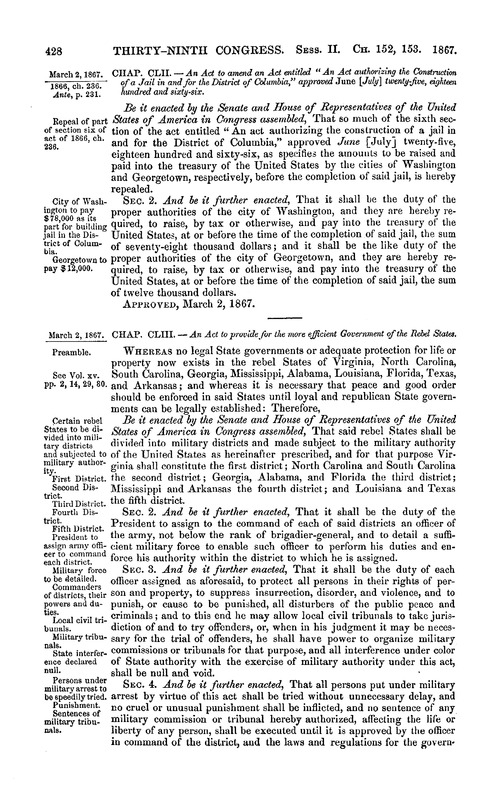
Radicals succeeded in obtaining a two-thirds Congressional majority that enabled them to begin Radical Reconstruction during the Second Session of the Thirty-ninth Congress. They believed that Congress controlled Reconstruction as well as how to integrate the Southern States and to protect Freedmen. The 1866 election enabled Radical Republicans to enact their agenda without Johnson’s approval. Congress granted Black Suffrage in Washington D.C. in January 1867 and completed their Reconstruction blueprint. They decided that Freedmen should vote, the Southern government should be superseded by the federal government and that former Confederates are excluded from the Federal government. Radicals continued to propose legislation to protect Freedmen through the Reconstruction Acts.
Congress utilized the Reconstruction Acts to divide the South into military districts to force the former Confederate States to pass the Fourteenth Amendment. The first act reshaped the eleven southern states into five temporary military districts. Each state had to rewrite their constitution, allow Freedmen to vote, and ratify the Fourteenth Amendment before being readmitted into the Union. This allowed Radicals to control how southern states were admitted into the Union. Radical Republicans went further to pass the Second Reconstruction Act on March 23, 1867. This enabled the military to register Freedmen as voters and to elect delegates to draft new state constitutions in the South. Congress passed the Third Reconstruction Act on July 19, 1867, which gave the five district military commanders additional power to remove state officials that hindered Reconstruction. Southern opposition refused to vote, which prevented the ratifying of a new constitution. Radicals passed the Fourth Reconstruction Act on March 11, 1868, to state that a majority of votes cast is enough to form a new state constitution. This enabled Radicals to regain control from Southerners as any freedman could vote in a district if he lived in the district for at least ten days before the election. Radicals worked to secure Freedmen’s rights after the Civil War that resulted in the Fifteenth Amendment to guarantee Freedmen’s right to vote. African Americans worked with white Unionists to elect state governments across the U.S. in Virginia and local governments within cities and counties.