Alexandria Municipal Election March 5, 1867.
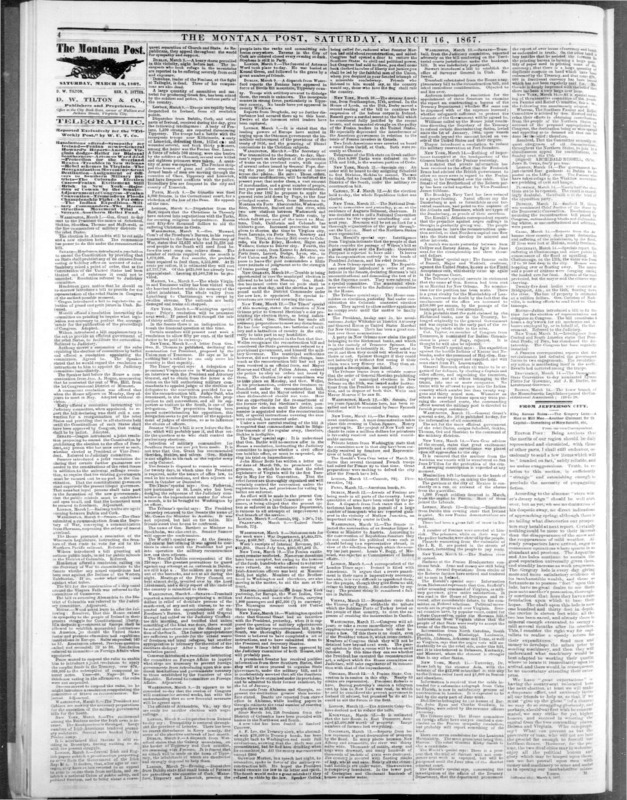
Virginia Radical Republicans increased their demands for Freedmen’s suffrage in 1866 before the Fourteenth Amendment. Freedmen organized at the Lyceum Hall on March 2, 1867, and argued they deserved the right to vote from the First Reconstruction Act. The article stated, “A mass meeting of the colored population of this city and vicinity, to the number of two or three hundred … under the provisions of the “Force Bill” negros had a right to vote in the municipal election to-morrow.” Freedmen expressed their right to vote for the Republican ticket. They spoke at the meeting and argued in favor of their intelligence and ability to vote for their chosen Republican candidate. The Fourteenth Amendment allowed Alexandria Freedmen to remain protected through its Equal Protection Clause, which stated all persons born or naturalized within the United States are U.S. citizens and are entitled to life, liberty, and property. No citizen may be infringed upon their rights listed above. The Virginia General Assembly did not ratify the Fourteenth Amendment until October 8, 1869, when it became required to be readmitted into the Union. Alexandria Freedmen inspired other Virginia Freedmen to advocate for Black Suffrage because of Freedmen’s initiative to vote in elections. Freedmen’s ability to vote in Alexandria elections on March 5, 1867, demonstrated agency through their desire for Black Suffrage and a voice in government.
The First Reconstruction Act guaranteed Freedmen’s right to vote through its language. The Act divided former Confederate states into Military Districts with Virginia as the First Military District. President Johnson subsequently assigned Union General John M. Schofield as commander of the First Military District. The Act stated, “in all elections to any office under such provisional governments all persons shall be entitled to vote.” Freedmen viewed the Reconstruction Act as their right to vote in the upcoming election. They voted in previously designated alternative locations to ensure that all Freedmen had the chance to cast their vote.
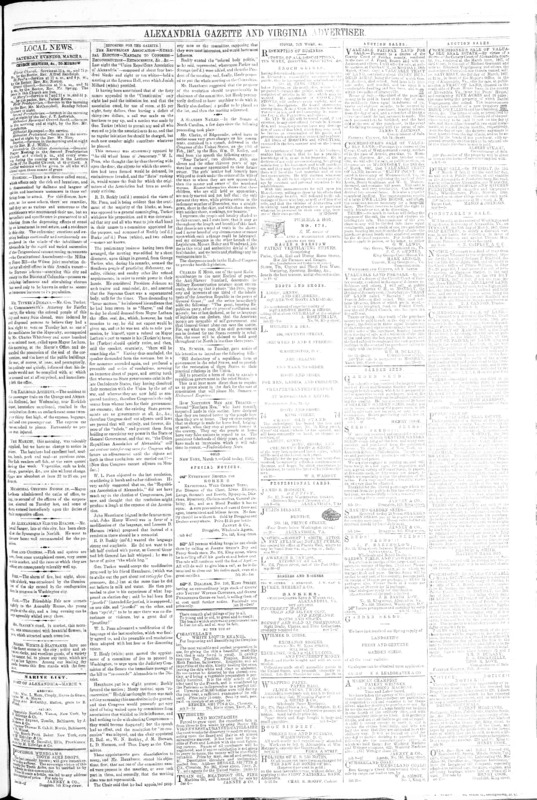
Alexandria Freedmen voted in the 1867 local election as recorded by the Alexandria Gazette. It stated, “It is evident that the negros are to vote at to-day’s election… If they cast a majority for their candidates, they will contest the election.” Alexandria Freedmen were successful in their attempts to vote in the election that resulted in several Republican candidates being elected to local public office. The large percentage of African American votes consisted of a majority of votes cast. Approximately one thousand three hundred and sixty-five Freedmen cast their votes for the Republican ticket compared to only an estimated seventy-five or eighty votes by white northerners. The Alexandria government appealed to Johnson for guidance on the course of action and whether Freedmen votes were to be included in the final total. Freedmen attempted to vote on March 5, 1867, that forced Alexandria Mayor Hugh Latham to meet with Johnson to decide if Freedmen’s votes were to be counted. Johnson and Latham reached a compromise to allow Freedmen to vote but that their votes were not counted in the final tally. Johnson sent two companies of U.S. troops into Alexandria to maintain order. Approximately one thousand Freedmen in Alexandria voted for the Union ticket. Therefore, Freedmen’s votes were not counted in the final results that resulted in the Conservative victory of 1867. Alexandria Republicans and Freedmen believed they were cheated of their right to vote for elected officials and to have their votes counted toward the final number of votes. Fourteen hundred Alexandria Freedmen attempted to vote in that election that forced later events such as negro suffrage. Pierpont reconvened the Virginia General Assembly and warned that negro suffrage was inevitable after Freedmen’s display of agency.
The Alexandria Virginia Republican Union Association worked to guarantee Freedmen’s suffrage since the Alexandria Colored Convention of 1865 until the ratification of the Fifteenth Amendment on February 3, 1870, after the end of Virginia Reconstruction. The Association met almost every week after March 2, 1867, as documented by the Alexandria Gazette. Union Association members consisted of Freedmen such as Alexandria native Rosier D. Beckley and eventual Alexandria politician George Lewis Seaton and were attended by various Alexandria Freedmen and Alexandria white northerners. Association members began to meet before March 2, 1867, to discuss the idea of Black Suffrage. The Alexandria Union Association became an intense reminder of how Freedmen’s ideas on their lives after emancipation changed. Freedmen continued to attend meetings, debate ideas and vote on how to proceed at later meetings. The Alexandria Union Association later allied and merged with other groups such as the Fourth Ward Radicals and Thaddeus Stevens Republican club to provide Alexandria Freedmen with a greater voice to argue for Black Suffrage. The Alexandria Gazette stated “Beckley concluded his remarks by assuring his “white brethren” of the South that if they would bring forth fruits mete [meant] for repentance that the colored people would willingly take them into fellowship.” The Association subsequently met on various days after March 2, 1867, to select nominees for public office and continue to advocate for Freedmen suffrage. Alexandria Mayor Hugh Latham subsequently won reelection to serve until 1868.
The Reconstruction Acts on March 2, 1867, and March 23, 1867, allowed Alexandria to continue to advocate for Freedmen’s suffrage and to elect delegates to the Virginia Constitutional Convention of 1867 - 1868 to draft a new state constitution. Nevertheless, Union General Scofield issued an order to suspend all elections until the end of Virginia Reconstruction. The election occurred in Richmond between October 18, 1867, and October 21, 1867, to select delegates for the convention. Alexandria-nominated John Hawxhurst was chosen to represent the town at the convention. Hawxhurst and John C. Underwood later worked to ensure Freedmen’s suffrage in Alexandria and the state of Virginia. Alexandria Freedmen advocated for their right to vote through Hawxhurst. Freedmen voted to send a majority of Radical Republican delegates to the Constitutional Convention to obtain a majority with support from the Republican Party against Conservatives.